This story in the BBC about boadroom pay rather worries me. While I have a great deal of sympathy with Nick Clegg's frustration at top managers getting big rewards for failure I'm not convinced it is something the government should intervene in directly.
The people who should decide who is on the board, and therefore the renumeration committees that set pay, are the shareholders. Shareholders have a stake in the company's success or failure, if they feel the need to get a big salaried, high flyer to run the company is it right for the government to tell them they can't? If government policy prevents a preferred candidate getting recruited can the company get some form of recourse if the second preference candidate turns out to be a flop?
The government should not dictate how the private sector reward their top talent. How would Manchester United fans feel if the government prevented Sir Alex Ferguson from paying Wayne Rooney the money he felt he deserved?
Labour want to legislate to force companies to have members of staff on the renumeration committee. Many companies do this already and I can see lots of advantages in doing so, but once again I feel very uncomfortable with the idea of forcing all companies to do something just because I think it's a good idea.
Showing posts with label Nick Clegg. Show all posts
Showing posts with label Nick Clegg. Show all posts
Sunday, 4 December 2011

Friday, 18 February 2011
No to AV, Don't blame Clegg - blame the system
Some Conservatives, and others, will find it tempting to use the AV referendum campaign as a chance to attack the Lib Dems in general and Nick Clegg in particular. This would be both unfair and unwise.
The Lib Dems have long been proponents of an electoral system which creates hung parliaments and coalition governments, when presented with circumstances to form a coalition it would have been ridiculous for Nick Clegg not to have taken up the opportunity. I suspect that Clegg and the Lib Dems were surprised by the reality of coalition negotiations and the compromises that need to be made, it is clear that the bulk of the party is no more comfortable with it than Conservatives are.
Clegg's unpopularity has mainly been driven by his total u-turn on tuition fees. Many students and Lib Dems supporters are furious at what they feel is a sell out by Clegg. But what would any other Lib Dem leader have done in the same position?
The Lib Dems are the junior partner is a coalition and will get less of their agenda implemented than the senior partner, Clegg had to decide what his bottom line was going to be in those few days in May and he chose a referendum on changing the voting system. A different person as party leader might have picked something else, but I doubt it. To get the referendum Clegg had to drop a number of Lib Dem manifesto commitments, this doesn't indicate weakness or dishonesty on Clegg's part, it is the natural byproduct of coalition government.
People who are angry at Nick Clegg should really be angry that he was forced into dropping long standing manifesto commitments by the needs of coalition. They should be angry that the commitments that both Lib Dem and Conservative ministers work by are the ones in the coalition agreement not either of the parties' manifestos. They should be angry that when it comes to holding those MPs to account at the next election they will all have a sound defence in that their hands were forced by the needs to make a coalition work.
All the things which people are getting legitimately angry about are not the fault of Nick Clegg but they are the fault of the electoral system that he supports. Say no to AV not because of Nick Clegg but because AV is a bad system which will make politicians less accountable to their electors.
Wednesday, 21 April 2010
Vote Clegg get Brown
 Remember before the last General Election we warned you all that a vote for Blair would get Brown? You didn't believe us and look what happened, one of the worst Prime Ministers in British history.
Now, when we warn you that there is a very real chance that if you vote Clegg you'll get Brown please pay attention. You'll kick yourselves later if you don't.
Friday, 16 April 2010
First leaders debate - my thoughts
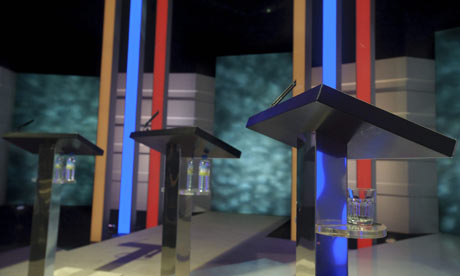 Nick Clegg came out on top. I don't think that anyone other than the most devout of the party faithful would try to say any different. So what does last night actually mean, who were the real winners and losers?
Let's start off with Labour. I suspect the Brown team thought that Cameron hadn't been properly quizzed and that these debate would uncover some gaping hole in Conservative policy or in DC's personality. Alistair Campbell has been moaning about the easy time the Conservative leader has been getting from the media and Brown's line about "this isn't Question Time it's answers time" is quite telling. Everyone knows Brown isn't as good in front of the camera as Cameron but his poor poll position meant that it was worth the risk of him being "beaten" by the Tory.
Nick Clegg was the big winner before a single word was spoken just by being an equal player in these debates. The third party has always had the advantage of being able to sound reasonable, put forward a wish list that they'll never need to implement and get less scrutiny than either the government or the opposition. This is exactly what happened last night.
David Cameron went into the debate with the highest expectations and the most to lose. If either Clegg or Brown performed better than expected it would be Cameron who would be seen as having lost ground.
From my point of view Brown was as dire as I expected, Cameron a little more nervous than I would have thought and did not perform to his full potential and Clegg did better than anyone predicted.
I still cannot understand why the debate made no attempt to tease out the Lib Dem's plans in the event of a hung parliament. To quiz them as though they might form the next government is ridiculous, even on their best possible performance they will not get a majority. I don't believe the questioning was biased or easy on Clegg but voters still have no idea what deals they would try to cut or what policies they would dig their heels in over.
The result last night presents each leader with a new position. Clegg now has the toughest job, Brown is clearly trying to woo voters with his constant "I think Nick agrees with me" lines and Clegg will come under pressure to either move closer to Labour or closer to us. He will also go into the next debate with expectations sky high. Might he have peaked too early?
Brown was crap, his gags looked forced, his smile looked painted on and his attempts to reach out to Lib Dem voters was about a subtle as a neon light. He went in with the bar set pretty low and yet he still managed to underperform. A rare gift indeed.
David Cameron could have lost a lot, he didn't. But the truth is he didn't really gain anything either, a neutral end result. He has a decent platform for the next two debates and now has a far easier job.
I'm fairly happy with the result, a big win for Cameron would have been nice but I'm not sure it would have been such good news in the long run. If everything had been the same as last night but with Clegg not quite as strong, but sill coming out on top, I would have put it down as the perfect result.
Wednesday, 31 March 2010
Leaders debates
The recent Chancellors debate on Channel 4 has got me thinking about the style of questioning, particularly of Nick Clegg.
Many have questioned the legitimacy of having the Lib Dems represented at the debates with the same status as Labour and the Conservatives as there is no real chance that they will form a government. The defence is that there is a very real chance of a hung parliament and in such a case the Lib Dems would be king makers. Fair enough.
But if that is the bases for their inclusion why are they questioned as if they might form a government? Gordon Brown and David Cameron should be asked about their policies and plans in the event of their respective parties winning, but Nick Clegg should be quizzed on what he would do in the event of a hung parliament. People deserve to know what policies they might support, what price would their support command and whether they would form a formal coallition or decide on a vote by vote basis.
If they do not cover these points I really cannot see the justification of having the Lib Dems in the debates at all.
Wednesday, 30 July 2008
Nick Clegg admits defeat
I don't usually link to Lib Dem stuff but I thought that this video needed as wide a coverage as possible.
It's not just the hammy acting and the dodgy camera work (who am I to talk) it is what he is saying that is worth watching. As far as I can make out he admits that the Lib Dems have no hope of forming a government, that they cannot beat the Conservatives and that they have no money.
How did I draw those conclusions? Here's how.
No hope of forming a government: He said that the Lib Dems would target 50 seats where they are second place to Labour. They have 62 MPs at the moment 62+50=not enough MPs to form a government.
They cannot beat the Conservatives: He said that he was going to move resources to fight these 50 seats, where from? The logical place to move resources from is from Conservative/Lib Dem marginals.
They have no money: He asked for viewers to did into they pockets to help him make these changes. That doesn't sound like a reallocation of financial resources to me, it sounds like a plea for new money.
What a compelling message to give to the troops after weeks of near silence.
Subscribe to:
Posts (Atom)